
|
The world of prefab and modular homes. |
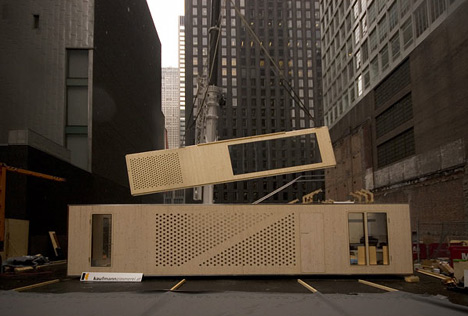
In the mail from  Michelle Kaufmann Designs: If you were unable to see their mkSolaire on display, you now have a second chance.
We are so deeply pleased that the Museum of Science and Industry has decided to extend the Smart Home exhibit’s run through January 2010! Having closed on January 4th, the exhibit will reopen its doors on March 19th, ready to share even more new ways, big and small, that people can lead eco-friendly lives.
MKD has added the above video to their Web site. It shows the assembly of their mkSolaire at the museum in Chicago. Fun to watch.
There are plenty more where that came from.
Earlier this month on her New York Times blog, Allison Arieff posted a well-argued commentary on MoMA's Home Delivery show:
The puzzling thing about "Home Delivery" is its focus on homes that you can’t actually have delivered. The exhibition is chock full of gorgeous and historically significant architectural drawings and models, but the curatorial agenda of the show is muddled.
Specifically:
...it’s hard to understand the decision to exclude from the exhibit the small but significant group of architects who are actually producing prefab homes on a significant scale today.
She mentions:
-
Michelle Kaufmann Designs
-
Rocio Romero
-
Resolution: 4 Architecture
- IKEA's BoKlok
In contrast, Arieff liked the Whitney Museum's now-closed show on housing pioneer Buckminster Fuller:
Eccentric to be sure, this visionary couldn’t have been more prescient with his concerns about the way we live.... In contrast, "Home Delivery" has tons of cool stuff to look at, but it really does feel odd that a show about homes has so little to say about the experience of actually living in one.
I'm sorry that we missed that one.
Read the full post for more details; Arieff knows the field.

|
The Washington Post discussed MoMA's Home Delivery show earlier this week, leading with a quite provocative line:
The architect who masters prefabricated housing -- how to make homes that are well designed, mass-produced, affordable and easy to build -- may well go down in history as the Last Architect.
Got my attention, at least. The article continues with the prodding:
As a fascinating and important new Museum of Modern Art exhibition, "Home Delivery: Fabricating the Modern Dwelling," makes clear, they have mostly failed. But if anyone ever succeeds, perhaps the grand challenge of domestic architecture would be over -- time's up, pencils down.
The article makes many such observations and poses a few questions:
The paradox of the prefab dream, which began with proles in boxes, is that it lingers in the bourgeois craving for luxury goods and second houses.
And so does prefab turn out to be just another designer accessory, not so different from Louis Vuitton handbags or Prada shoes, industrial status symbols that are basically the same from unit to unit? Is it true once again that the blessings of modernism, supposedly a gift for the many, are really just a prize for the few?
Some specific thoughts on the homes in the show:
the ridiculously small confines of the Micro Compact House will [not] leave you with any desire to live there.
the System3 project ... is a compelling piece of architecture by any standard.... Stand in the System3 for a few moments, and you want to live here.
In summary:
"Home Delivery: Fabricating the Modern Dwelling" will leave you honestly conflicted, dubious about where history has brought the prefab dream. And more than ready to move into a prefab castle, just as soon as you can buy a nice plot of land and muster the down payment...
What do our readers think about The Posts's observations? Have most of prefab's early practitioners failed? Is prefab just a "prize for the few?"
While reading the full article, be sure to check out the accompanying slideshow.
|
| http://www.slate.com/id/2197176/slideshow/2197362/fs/0//entry/2197359/ |
Witold Rybczynski filed a slideshow report from MoMA's Home Delivery show. In his usually candid style, he gives his impressions of the show, inside and out:
Prefabricated houses have remained an elusive goal for architects, and the MoMA show is a stylish litany of second-place finishers, also-rans, if-onlys, and downright losers.
I'd dare to say that just being included in the MoMA show makes each of the featured projects a first-place, upright winner, but maybe that's just me. Anyway, back to Witold:
After considering some 500 firms, the museum chose younger, lesser-known architects, and the range of solutions demonstrates both a sense of enthusiasm and a variety of novel prefabrication technologies.
He shares his thoughts on the BURST*008:
The rather crudely built structure looks out of place here—or, I suspect, anywhere.
The System3:
most people's idea of contemporary prefabrication: It's elegant, stylish, and rather austere.
Larry Sass's Instant House:
an ingenious and very complicated answer to the wrong question. ... The laser-cut decorative fretwork on the porch is nice, though.
The m-ch:
Nothing revolutionary here, but a very nicely designed package.
(Though he suggests buying an Airstream trailer instead.)
And the Cellophane House:
The design, fabrication, and construction are seamlessly integrated, and the various pieces are automatically ordered from the fabricator to suit the design as it is entered into the architect's computer. If there is a Next Big Idea in prefabrication, this may be it.
For the rest of Rybczynski's thoughts and some great photos, check out the whole slideshow at Slate.
|
| http://www.homlifestyle.com/ |
A busy week!
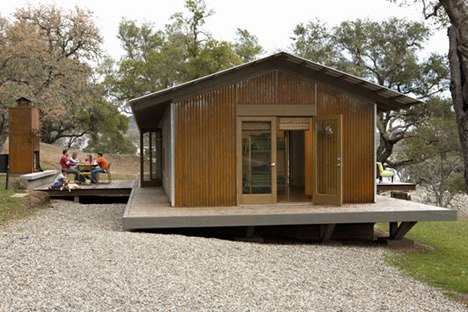
Inhabitat's Prefab Friday enjoyed Method Homes' cabin:
we’re happy to report that Method Home’s modern wood wonder has blossomed into a beautiful home.
Inhabitat also covered HOM:
Simple, purposeful, ecological and crafted, HOM houses are meant as secondary residences; a HOM away from home to which busy urbanites can escape in style.
Jetson Green wrote about a container home in San Francisco, designed by Leger Wanaselja Architecture:
It's a simple design that shows what [is] possible with innovative home construction.
Visit Jetson Green for the full post and a bunch of photos of the home. The previous day, Preston previewed the West Coast Green showhome:
It's a 1700 sf container home, but you probably can't tell just by looking.
We'll cover West Coast Green and the showhome in more detail soon.
And a little more news on MoMA's Home Delivery show. New York's The Villager discussed the show:
“Home Delivery" ... is a coup for quality. It’s also a tour of prefab past, a spiffy toy store of drawings, models and actual toys from the century-plus history of industrialized home construction.
Business Week reran a short article from Architectural Record on the show:
One of New York's most exciting cultural venues this summer is a vacant lot in Midtown Manhattan....
Moco Loco ran a series of posts on their favorite three homes in the show. They introduced the show Monday. On Tuesday, they covered the System3 house:
Inside, its austere bearing gives way to a more luxurious simplicity...
Wednesday's post featured an interview with Cellophane House designer James Timberlake:
What will happen to this particular home on October 21? We are working on this concurrently with the show. We have discussed the possibility of auctioning the house.
Thursday's post looked at BURST*:
But marveling at the architecture is not the point of BURST*. Ultimately, the structure puts the emphasis on nature: The house’s rear elevation unfurls in a cascade of bleacher-style seating, all the better to sit and enjoy the view—out.
Listen (~16:00) to a broadcast from New Hampshire Public Radio about the show, featuring an interview with Stephen Kieran of KieranTimberlake Associates.
Bloomberg Television's James Russell reviewed the exhibition:
... a wildly ambitious display of the pleasures and peculiarities of prefabricated houses. The prototypes, augmented inside the museum by a rich history of the genre, capture both the earnestness of architecture's obsession with industrial technique and its faith in technology as an agent of progress.
Read the whole thing for some specific criticism -- and possible upside.
USA Today offered an overview:
an engrossing survey of the prefab movement...
The New York Times profiled BURST*08 and architects Jeremy Edmiston and Douglas Gauthier. The path to realizing the home was not an easy one:
... arranging all the parts into the right piles so they could just be snapped into place at MoMA turned into a logistical nightmare lasting weeks rather than days. While they sorted, the 15 or so architecture students on hand were trying to reassure the contractors about a model that looked as sturdy as a collapsible fan. As for the architects, they were running back and forth to their offices, scrambling to update the drawings and struggling to raise money.
The full chronicle of the home's construction is worth a read, but sadly, it sounds like we won't be seeing future prefabs from the pair:
For the two architects, however, the success is bittersweet. After nine years their partnership has ended. “This is our last project together,” Mr. Edmiston said.
New York Magazine's architecture critic also reviewed the show:
This sporadically exciting but ultimately diffuse show begins indoors, on the sixth floor, and sidles up on the present by way of the past. It opens, brilliantly, with both....an exhibit that can’t quite decide whether prefabrication should be treated with irony or exuberance.

|
Dwell reports:
...for those who can’t visit the city anytime soon, the museum now has an online version of the show, replete with installation videos, archival footage, and an interactive timeline of prefab housing.
Admittedly, clicking through Home Delivery can’t beat scaling the five structures that now stand in the museum’s adjacent lot. But it’s certainly the next best thing.
The online exhibition takes over the top portion of the blog. It's quite comprehensive; well worth a look.

|
MoMA's Home Delivery exhibition opened this weekend. The blogs were full of coverage.
Voxant's TheNewsRoom includes a video report. (Note: the video is interesting -- but runs automatically, may be slow, and may cause browser problems.)
Zavod Big, a design blog in Eastern Europe, covered the "Touch" home from Kannustalo of Finland.
Green in Medusa featured some beautiful images of the show, plus this note:
Whether you like these architects and the concept of Pre-Fab or not the show is worth visiting.
Treehugger featured pictures last week and a look at several reviews on Monday.
Dwell shared some photos.
Core 77 showed off an image of a futuristic wall fragment at the show.
future forum 2008 included exquisite photographs, interesting discussion, and this conclusion:
HOME DELIVERY is an impressive narrative about both failures and successes of the concept. What is evident in the optics of the MoMA showcase is that prefabricated homes have evolved over the years and now come in astonishing variety and appeal to the most sophisticated expectations.
C-MONSTER.net also has photos.
|
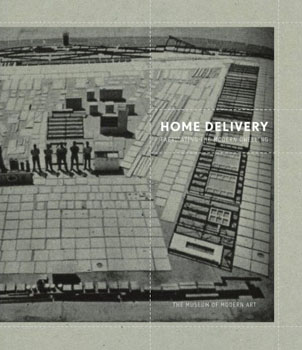
MoMA's exhibition catalog is available for purchase (Amazon, sale price $29.70), but won't ship until August 1.
The catalog includes three essays:
- "Home Delivery: Viscidities of a Modernist Dream from Taylorized Serial Production to Digital Customization" by Barry Bergdoll [curator]
- "Scandinavia: Prefabrication as a Model of Society" by Swedish historian and critic Rasmus Wærn
- "Postulating the Potential of Prefab: the Case of Japan" by Ken Tadashi Oshima, a historian of Japanese architecture.
Other contents:
- "substantial descriptive texts" of each of the 63 projects in the show, written by Peter Christensen
- contributions from guest authors Robert Rubin, Friedrich von Borries, and Florian Breipohl
- a chronology of prefabricated buildings
- a selected bibliography
Sounds like a must-have.
|
| http://www.nytimes.com/slideshow/2008/07/18/arts/0718-DWELL_index.html |
The New York Times architecture critic provided a glowing review of MoMA's Home Delivery in this morning's paper:
"Home Delivery: Fabricating the Modern Dwelling," which opens on Sunday at the Museum of Modern Art, is a delightful surprise....In a tour de force Mr. Bergdoll [the show's curator] was able to build five full-scale model houses for the show in a lot just west of the museum. The effect is startling: expressions of a suburban utopian world surrounded by Midtown’s looming skyscrapers.
Mr. Bergdoll has not only managed to track down some unexpected gems, he has also arranged them in a way that allows us to see them with fresh eyes. He makes a convincing case that prefabricated housing was both a central theme of Modernist history and a dream that remains very much alive today.
We've provided extensive coverage of the full-scale homes; this review adds details on the accompanying exhibits:
[the show] presents more than 80 projects, from humble experiments in suburban living to stunning works of cretive imagination.
Here's a sample: (plus some external links we dug up)
- wall fragments from architects Rahim, Hina Jamelle, Jesse Reiser and Nanako Umemoto
- One Week: "a 1920 Buster Keaton film in which fumbling young newlyweds try to assemble a prefabricated house"
- the Manning Portable Cottage: an 1833 prefab that "could be conveniently packed in a ship's hold and reassembled."
- the 1931 Copper House: "designed by the Modernist master Walter Gropius. It was conceived as a system of insulated copper wall panels that could be easily transported and assembled on site in 24 hours."
-
Jean Prouvé's Maison por l'Institutrice: "a reworking of his 1948 Maison Tropicale, a masterpiece of prefabricated design."
- the Lustron House: "modern technology draped as nostalgia"
- Archigram's 1965 Living Pod: "an amoeba-shaped capsule with mechanical systems plugged into the side"
- Kisho Kurokawa's Nakagin Capsule Tower, which was slated for demolition last year
- Primitive Huts by Wes Jones
- works from Greg Lynn and Teddy Cruz
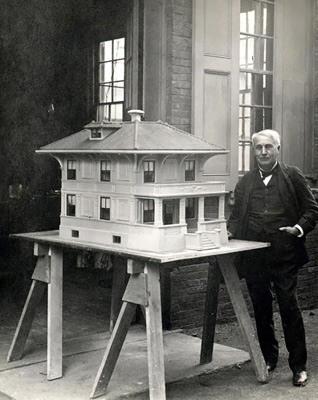
- Thomas Edison's Simple Concrete House System
Read the full article for more details and a new slideshow with 12 images.
One correction to the article: the frame of the Cellophane House is aluminum not "lightweight steel."
|
| http://kierantimberlake.com/featured_projects/cellophane_house_1.html |
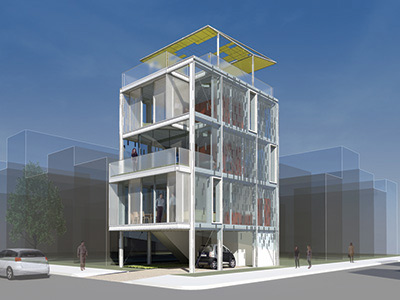
Last week, Lloyd Alter wrote about KieranTimberlake's Cellophane House ... which reminded me that we hadn't yet covered it in detail. The home is one of the five in MoMA's Home Delivery exhibition.
Referencing a talk given by Steven Kieran and James Timberlake a few years back, Lloyd explained why the Cellophane House is so exciting:
I saw that prefab wasn't just about building in a factory, but was about reinventing the way we build, not just where.
...
"Chunking" is what car manufacturers do; they have subassemblies that are put together into modules, and then put together into the finished product. Builders already do a bit of that, buying pre-hung doors and nail-in windows. KieranTimberlake take it to the next level on the Cellophane House.
Visit Treehugger to read Lloyd's complete post.
Here's more info from the KieranTimberlake project page for the home:
Cellophane House is a five-story, offsite fabricated dwelling... The 1800 square-foot residence has two bedrooms, two bathrooms, living and dining space, a roof terrace, and a carport.
Like their Loblolly House, this one is designed to be easy to put together and take apart.
Cellophane House relies on a system of customizable elements. An aluminum frame serves as a matrix on which other factory made elements like floors and ceilings, stairs, bathrooms, and mechanical rooms can be attached. The aluminum structural framing is bolted, rather than welded, allowing it to be taken apart as easily as it is assembled. Moreover, this frame allows any of the walls, floors, structure, or envelope to be replaced at any time, without invasive modifications.
They describe the concept using soaring rhetoric:
A building is, at root, nothing more than an assemblage of materials forming an enclosure. We recognize that these materials came from somewhere, are held together for a time by the techniques of construction, and will at some future time transition into another state. While we tend to think of buildings as permanent, they are in fact only a resting state for materials, a temporary equilibrium that is destined to be upset by the entropic forces that drive the physical universe.
Definitely worth a view: a time-lapse video of the home's assembly.
I'll give Lloyd the final word (as I'm inclined to agree):
[The Cellophane House is] a demonstration of pushing the technological building envelope to the very edge; like so many things that came out of the space program that are now part of our everyday life, there are ideas here that in ten years will probably be part of every building.
|
| http://www.nytimes.com/slideshow/2008/07/09/arts/20080709_PREFAB_SLIDESHOW_4.html |
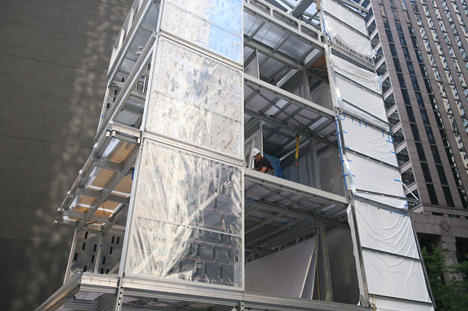
Today the New York Times published an online slideshow documenting the progress of the homes in MoMA's Home Delivery exhibition.
Definitely worth a view.
This last week has seen some impressive progress in the installation of homes for MoMA's Home Delivery exhibition, opening July 20.
In the video above, the System3 home hatches from its shipping containers and is craned onto its temporary foundation in midtown Manhattan. The bones of the BURST*008 model can also be seen in the video, from about 0:10 to 0:25.
Visit the Home Delivery blog for up-to-the-minute blog posts, images and videos.
|
| http://www.nysun.com/arts/turning-a-1200-piece-puzzle-into-a-home-with-moma/78789/ |
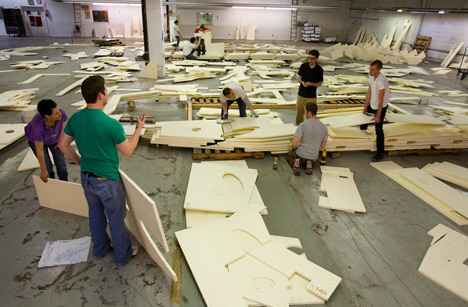
With MoMA's Home Delivery exhibition just 6 weeks out, signs of substantive progress are appearing. And it's definitely fun to follow along.
From an article in the New York Sun last week:
Inside a 20,000-square-foot warehouse space in Brooklyn's Gowanus neighborhood, about two dozen people gather most weekday mornings to work on a giant plywood puzzle. There are square-shaped pieces with oval holes in their midsection and jagged ones, resembling enormous saw blades. When they complete the 1,200-piece puzzle, they will have built a house -- or at least the skeleton of one.
Next week, that residence — collapsed into three accordion-like pieces — will be loaded onto a flatbed truck and taken to a vacant lot abutting the Museum of Modern Art. There, the design of the New York architects Jeremy Edmiston and Douglas Gauthier will rise in June, alongside four other modern dwellings
The article speaks of Burst*.008 from Gauthier Architects. We get a little more info from the MoMA Home Delivery blog:
So far the hiccups we’ve had have been solved by the application of elbow grease and collaboration. Our gratitude to all who have given us both.
Other homes are also moving along. Kieran Timberlake's Cellophane House has a frame and quite a bit of glowing acrylic!
The System3 House is in a shipping container (very cool one minute video) somewhere in the middle of the Atlantic.
And, DelMarvaNow.com shared some details on the fabrication of the 'Housing for New Orleans' exhibition home. That home is a version of yourHouse by MIT's Lawrence Sass.
Check out the full Home Delivery blog to see videos, images and tons of updates on each home's construction. Read the full New York Sun article for more detail on the Burst* project and the exhibition.

|
| http://msichicago.org/whats-here/exhibits/smart-home/ |
We previously provided an overview of MKD's mkSolaire being installed at Chicago's Museum of Science and Industry. We also shared a video of the construction.
A couple weeks back, the home opened to the public. We haven't had the chance to visit, but many around the blogosphere have.
Dwell visited on May 8th and reports:
It was a gray and rainy day in Chicago yesterday, but ... Michelle Kaufmann's newest prefab was still producing more energy than it used.
The mkSolaire marks Kaufmann's entry into urban neighborhoods. Designed to fit into a standard 25 ft. wide city lot, the home is seven modules – five for 2500 square foot home and two for the garage, which is designed for flexible future use such as conversion to a guest house when the car is abandoned for good.
Jetson Green visited, along with the folks at PrairieMod, May 9th:
There are a couple of wonderful things about what this exhibit is doing. For example, it is making this approach to design completely accessible to the typical citizen in a relevant manner. It isn't just the stuff of highbrow design and shelter magazines. The Smart Home is absolutely real and is made for real people. It honestly inspires folks to see what can be accomplished with a thoughtful plan and current technology. Another exciting aspect is the fact that a prefab home can be built in the Midwest.
Also featured: an interview they recorded with Michelle Kaufmann.
Kaufmann's hometown newspaper, the Quad-City Times, reported on the home and filled in some details:
Admission to the house is $10, an extra fee for an exhibit celebrating the museum’s 75th anniversary and the 1933-34 "Century of Progress" Chicago World’s Fair.The idea for the exhibit came about during a brainstorming session as museum staff members considered an attraction from 75 years ago called "Homes of Tomorrow."
"We thought how amazing would it be to build a fully functioning home on the museum property that honors the past but is forward-looking with green and smart technologies," said Anne Rashford, director of temporary exhibits.
Once the idea was set, it didn’t take long to find Kaufmann, 39.
Exhibit details and images are available on the Museum of Science and Industry site.

|
| momahomedelivery.org |
MoMA is curating a blog for the Home Delivery exhibition. It went live Monday.
So far, Kieran Timberlake has posted on the Cellophane House:
STATUS:
- Design work including a full-scale mockup is 100% complete.
- 95% of the materials have been ordered.
- Structural materials for two chunks have been delivered to the factory.
- SmartWrap™ façade material is being fabricated at sub-contractors shop.
- Fabrication in the factory has begun.
And Douglas Gauthier and Jeremy Edmiston have updated the progress on their BURST*.008 design:
For Home Delivery, the fabrication method has evolved to account for a four to five week on-site construction timeframe, as well as the intricacies of house building in midtown Manhattan.
Check out the blog for weekly updates from each team: http://www.momahomedelivery.org/.
|
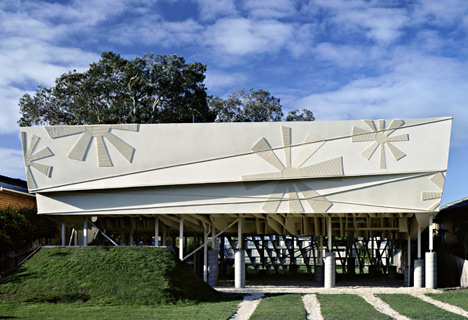
We received an email from Katherine Keltner at the offices of Gauthier Architects. She provided an update and correction regarding the BURST* model appearing in the upcoming Home Delivery show at MoMA:
BURST.003 was completed in 2006 under SYSTEMarchitects: Douglas Gauthier and Jeremy Edmiston.BURST.008 is being installed at MoMA and is designed as a collaboration between Douglas Gauthier [now at his own firm] and Jeremy Edmiston.
We'll provide more information on the BURST.008 model when details are released. In the meantime, check out the other coverage we have of the exhibition:
- Lawrence Sass' yourHouse
-
the m-ch
-
System3 from Oskar Leo Kaufmann and Albert Rüf
-
the BURST* model page
|
| treehugger.com |
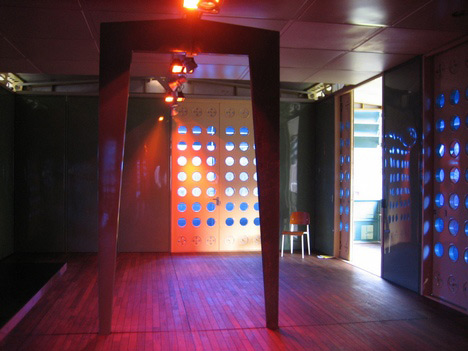
Treehugger shared some history of the Maison Tropicale:
It was discovered by Eric Touchaleaume who has been called the "Indiana Jones of furniture collecting". He has spent the last decade scouring remote parts of the world for valuable artifacts such as this house. Having bought 600 of Prouvé's chairs, he became obsessed with finding the house. Hearing that someone had seen one in Brazzaville, he travelled there and found two of them damaged by bullet holes and corrosion. It took six months to get the buildings out of the Congo because of the civil war and tribal conflicts.
Jetson Green covered a modern prefab in Japan:
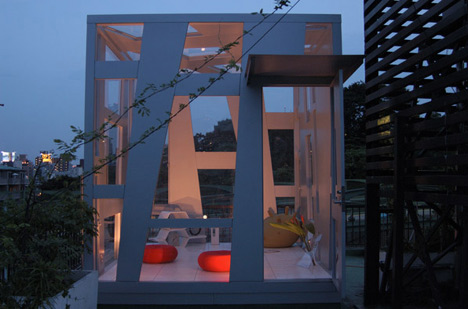
A group we've mentioned previously, useful + agreeable, is doing this by working with Atelier Tekuto to export his home designs outside of Japan.Using next generation prefab methods and modern materials, the pictured home design will be sold through the internet. The website lists designs as being available for purchase for $100,000...
Inhabitat's Prefab Friday looked at a series of prefabs from development firm Brio54. We will look at those more closely soon.
|
| nytimes.com/2007/05/16/nyregion/16house.html |
We covered several prefab and modular home conferences last year:
-
Hive Modular homes in Minneapolis and nearby St. Paul
- a LV Series home you can rent in the Napa Valley
- a Frank Lloyd Wright prefab in Pennsylvania
- a weeHouse in Minneapolis
And museum exhibitions about prefab, our favorite being the opportunity to walk through Jean Prouve's Maison Tropicale.
|
| magicboxusa.com |
Blogs couldn't get enough of The Magic Box, first seen on Moco Loco. Treehugger said:
Don't know what it costs, don't know what it's made of ... I will just say it is very pretty.
Jetson Green jumped in:
So I ask, after looking at the photos, does this Magic Box represent what's to come in the future? The Magic Box is cubic and versatile and small. It can go anywhere and be used as anything.
Not sure where The Good Human's Prefab Wednesday went, but they've been off since Jan. 3.
Inhabitat's Prefab Friday discussed a strange "prefab":
Winter shelter in the Arctic can take form in an upside down hunting boat – a traditional Inuit practice. Covey Island Boatworks, award winning builders of hand-crafted yachts, power and sailboats, has brought that idea into dry dock developing a prototype wood and epoxy prefab that applies boatbuilding principles directly to an extreme Arctic home.
Jetson Green showed off the flexibility of shipping containers:
It's hard not to gawk at the images of this building.
|
| nytimes.com |
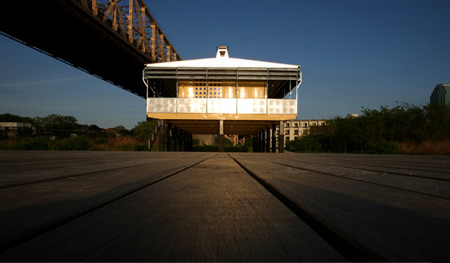
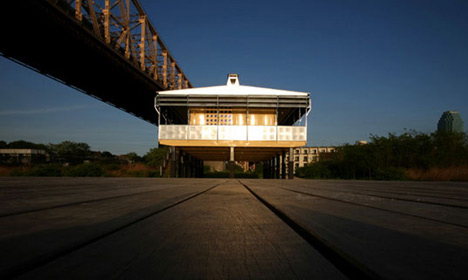
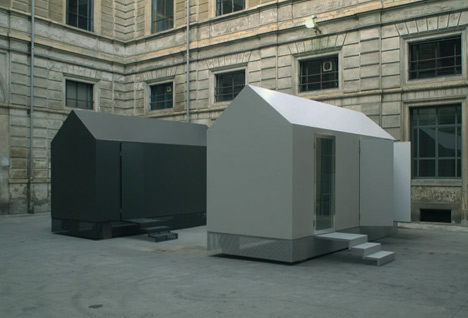
Jean Prouvé's Maison Tropicale, which we talked about last year, will be on display in London:
From the steamy jungle of Brazzaville in the Republic of Congo to the January drizzle of London's South Bank comes a tropical villa for the people. This weekend sees the construction of an unlikely addition to the capital's skyline: a prototype Modernist house designed in the Fifties by French architect Jean Prouvé.The historic colonial building, a kind of flatpack pioneer, has been brought to Britain for the first time by the Design Museum in partnership with Tate Modern. Today the gallery is halfway through reassembling La Maison Tropicale.... The Tate hopes the new house will be visited by as many as two million people.
|
| olkruf.com |
I wrote about Oskar Leo Kaufmann and Albert Rüf's System3 last week. It will be included in The Museum of Modern Art's Home Delivery exhibition.
The two designers have been working in the prefab arena since 1996. Past models include:
• System 01 and System 02 based on "elements"
• Su-Si, Fred, Houses A&B based on "units"
The System3 home merges the idea of "units" with that of "elements":
Due to the separation into serving units and "naked elements", the building process is optimized.
The serving unit is a completely prefabricated box including all installations. All different trades, such as electrician, plumber, etc. do their work at the service unit factory and do not have to do any on-site work....
The solid elements such as wall, floor, and ceiling are made of solid slabs of wood. The producer uses CNC-technology to cut out all openings.
...the window producer prefabricates all windows.
...the skin producer prefabricates the building's skin that includes thermal insulation, waterproofing and vapor barrier.
To me, it seems logical: keep the production of the technical pieces, the "serving units", in the factory where quality control can be tighter; let on-site work be limited to assembly and nothing more. This approach would save both time and money, limiting the trades and expertise needed at the home site; it reminds me of KieranTimberlake's Loblolly House, which we covered last June:
The assembly process begins with off-site fabricated floor and ceiling panels, termed 'smart cartridges.' They distribute radiant heating, hot and cold water, waste water, ventilation, and electricity through the house. Fully integrated bathroom and mechanical room modules are lifted into position. Exterior wall panels containing structure, insulation, windows, interior finishes and the exterior wood rain screen complete the cladding.(KieranTimberlake's Cellophane House will also appear in the MoMA show.)
Such a mixed-method approach compares to the two major types of prefabrication that we cover on Prefabcosm: SIPs (used by companies like CleverHomes and Jensys Buildings) and complete modules (like those from OMD and weeHouse). Using just SIPs leaves the majority of the skilled work for the site, e.g. installation of utilities. Complete modules are both expensive and difficult to get to the home site. Merging the two methods allows for greater flexibility, less cost, higher quality, and shortened construction time.
With 10+ years working on prefab, Oskar Leo Kaufmann and Albert Rüf are worth watching. While they have yet to translate their experiments into a mass-market product, their work lends much understanding to how the home-construction industry might best take advantage of prefabrication.
|
The Michelle Kaufmann blog announces:
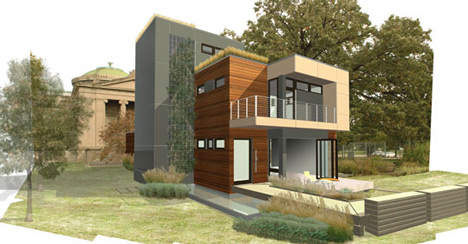
...we have been working very hard for the past few months to get to this point and are now finally ready and delighted to announce that MKD is going to be a part of the “Smart Home: Green + Wired, Powered by ComEd and Warmed by Peoples Gas” exhibit at MSI that’s opening this spring! The exhibit is going to include a full-size mkSolaire™ home to be built in on parkland on the southeast side of the Museum and will showcase the very best in sustainable living concepts and solutions.
A bit more from the museum exhibit page:
During its 75th Anniversary year, the Museum of Science and Industry will be building a functioning, three-story modular and sustainable “green” home ... to highlight unique home technologies for the 21st century.
The Greater Fort Wayne [Illinois] Business Weekly quotes Art Breitenstein of the home's builder, All American Homes:
The home’s module construction will be under way for two or three more weeks on one of the All American assembly lines in Decatur....“This is a special house, a very high-priced house; it has the best of the best. ... there’s a lot of new technology in there that’s one-of-a-kind that if it becomes accepted by consumers, like anything else, the price comes down of course.”
Jetson Green says:
I can't wait to see more!
|
| from Oskar Leo Kaufmann and Albert Rüf |
System3, from Austrian designers Oskar Leo Kaufmann and Albert Rüf, will also be showcased in MoMA's Home Delivery: Fabricating the Modern Dwellings show:
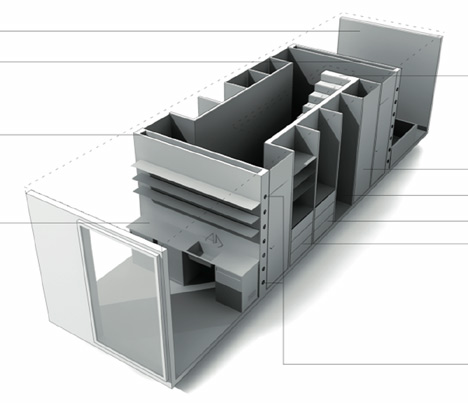
The system is based on the separation of a building into "serving space" and "naked space".The "serving space" is a completely prefabricated serving unit that provides all staircases, kitchens, baths, installations, electricity, heating, and cooling systems for the entire building. The "naked space" (space that is only defined by the placed furniture, such as living or sleeping rooms) is formed by "naked elements": solid slabs of wood...windows, skin. All "naked" elements are also prefabricated and are delivered directly from factory to building site, where everything can be assembled in a few days.
Each unit fits in a shipping container, giving it the characteristic "long and narrow" format. Several units can be placed side by side:
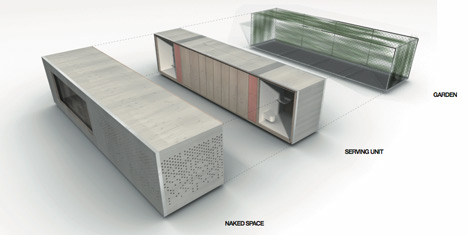
Or stacked:
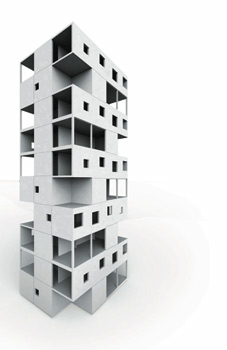
Overall, an intriguing approach that I can't wait to see realized at MoMA. Oskar Leo Kaufmann and Albert Rüf have been experimenting with prefab since 1996. We'll look at their past work in more depth soon!
|
| web.mit.edu/yourhouse/ |
Yesterday we reported on the Home Delivery: Fabricating the Modern Dwelling exhibition at MoMA. In the coming days, we will preview each of the companies and homes featured in the exhibition.
First, let's take a look at yourHouse, from Lawrence Sass at MIT:
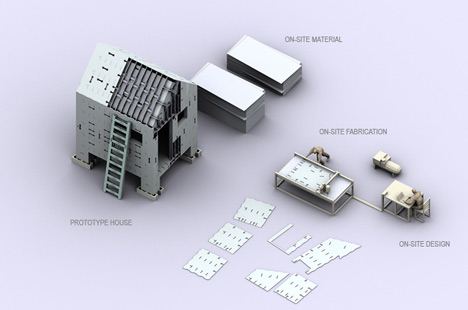
This design of yourHOUSE is a reinterpretation of historical New Orleans style “Shotgun” Housing utilizing recycled plywood as the main structural material. The house will be fabricated and assembled entirely of friction-fit components, completely eliminating the need for mechanical fasteners such as nails and screws. This fabrication technique is made possible through the extensive use of computer numerical control (CNC) milling machines....The goal of the yourHOUSE project is to exemplify a design process which utilizes cutting-edge technologies rooted in long term research efforts with the intent to illustrate a system that allows prefabricated housing to be low-cost and yet high-quality.
The processes include:
Digitalization
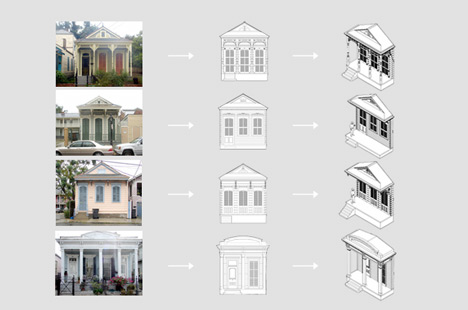
Digitalization is a 2-stage process which preceeds a materialziation process. First, 2-dimensional data was taken from the documentation and used to create elevation drawings. From this data, 3-dimensional data was extrapolated and digitally modeled so that the house facades could be transformed into solid physical models through a final materialization process.
Materialization
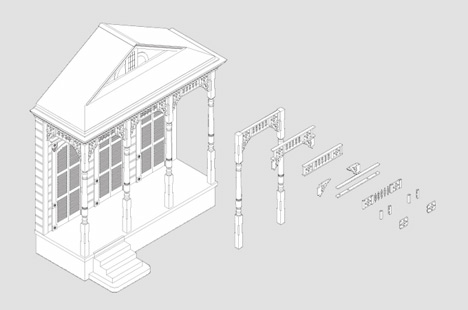
Materialization begins by breaking down the digital model into a logic of component parts and assemblies. In the figure above is one such breakdown of a front porch column assembly
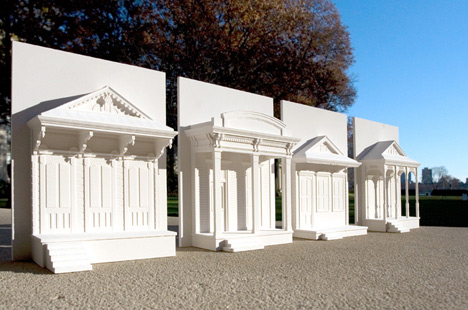
The final stage in the materialization process involves what is termed, 3D printing. This stage allows the researcher to examine the digital model as a solid physical body. In the figure above are 1:30 scale 3D prints of the four originally documented New Orleans 'Shotgun' house facades
The yourHouse concept also embraces customization:
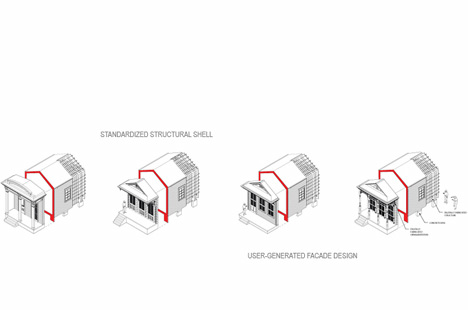
One of the core strategies driving project yourHOUSE is the use of mass-customized as well as mass-standardized components. This strategy happens at multiple scales ranging from details to major structural features. As seen in the figure above, the main body of the house employs a standardized structural shell while the front porch of the house can be customized to suit the inhabitant's desires.
It will be exciting to see this concept realized for the MoMA show.
|
| nytimes.com |
The New York Times reports:
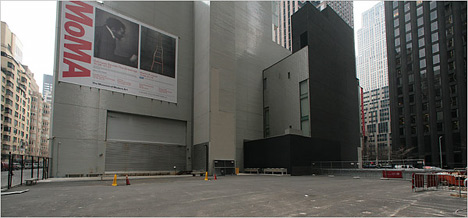
...the Museum of Modern Art has commissioned five architects to erect their own prefab dwellings in a vacant lot on West 53rd Street, adjacent to the museum. Whittled down from a pool of about 400, the five architects are participating in “Home Delivery: Fabricating the Modern Dwelling,” an exhibition opening in July.The five, to be announced today by the museum, are KieranTimberlake Associates of Philadelphia; Lawrence Sass of Cambridge, Mass.; Douglas Gauthier and Jeremy Edmiston of Manhattan; Oskar Leo Kaufmann and Albert Rüf of Austria; and Richard Horden of Horden Cherry Lee in London.
The MoMa site fills in some blanks:
This exhibition will offer the most thorough examination of both the historical and contemporary significance of factory-produced architectures to date. With increasing concern about issues such as sustainability and the swelling global population, prefabrication has again taken center stage as a prime solution to a host of pressing needs. The prefabricated structure has long served as a central precept in the history of modern architecture, and it continues to spur innovative manufacturing and imaginative design....The exhibition will examine this phenomenon through historical documents, full-scale reassemblies, and films that trace the roots of prefabrication in the work of architects including Frank Lloyd Wright, Jean Prouvé, and Richard Rogers, corporations such as Lustron, and the imaginative systems of other influential figures, including Thomas Edison and R. Buckminster Fuller.
This contextual component of the exhibition will provide the foundation for a handful of full-scale commissions to be built in MoMA's vacant west lot....The fabrication and delivery of these projects will be documented in a special online exhibition, which will underline prefabrication's importance as a matter of process over product. Furthermore, the delivery and assembly of these projects will function as a real-time urban event that will be visible to the general public from the city streets
A Prefab Project says:
Perhaps notable for the absence of any of the commercially successful prefab architects working in the US, still kind of a big deal...
Haute Nature also commented.
|
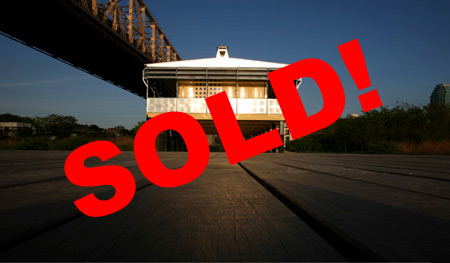
Jean Prouve's classic Maison Tropicale was sold last night at auction for $4.97 million, according to Bloomberg.com:
"'I just love Prouve,' said tanned hotelier Andre Balazs who bought the house and said he hasn't decided what he will do with it. Of one thing was he certain: 'It belongs back in the tropics.'"
The article added details on the house's history:
He sold one to American collector and former commodities trader Robert Rubin, who restored and donated his house to the Centre Pompidou in Paris. 'This price validates the other one,' said Rubin after the sale, speaking of the house he donated."

|
| walkerart.org |
The Some Assembly Required exhibit by the Walker Art Center will be opening at the Virginia Center for Architecture on June 15. (Hat tip: a post on Richmond Magazine's blog).
Tour locations to date:
Walker Art Center
Minneapolis, Minnesota
December 8, 2005-March 26, 2006
Vancouver Art Gallery
Vancouver, British Columbia, Canada
April 29- September 4, 2006
Yale School of Architecture
New Haven, Connecticut
October 27, 2006- February 2, 2007
The Museum of Contemporary Art, Pacific Design Center
Los Angeles, California
February 28- May 20, 2007
(our coverage links to a video report)
Marmol Radziner, FlatPak by Lazor Office, LV Series Homes by Rocio Romero, Mountain Retreat by Resolution 4: Architecture, Sunset Breezehouse by Michelle Kaufmann Designs, Turbulence House by Stephen Holl, and the weeHouse by Alchemy Architects

|
| walkerart.org |
The Some Assembly Required show organized earlier this year by the Walker Art Center in Minneapolis, is now on display at the Museum of Contemporary Art at the Pacific Design Center in LA:
"...the exhibition features eight modern modular house projects that have recently been realized. The designs address a range of approaches to prefabrication, including off-site construction, customized sections that are assembled on-site, and kits with plans and parts from which a house can be constructed."
Ecorazzi says "...you can see scale models of prefab homes, pictures, and samples of materials. Architects Marmol Radziner Prefab, Lazor, and Alchemy Architects are showcased..."
On Blogcritics, LX.TV files a video report about the show, featuring an interview with Leo Marmol of Marmol Radziner.
