The world of prefab and modular homes.

groHome can be taken apart

Link to groHome can be taken apart
http://www.lifecyclebuilding.org/2007/winner-grohome.php

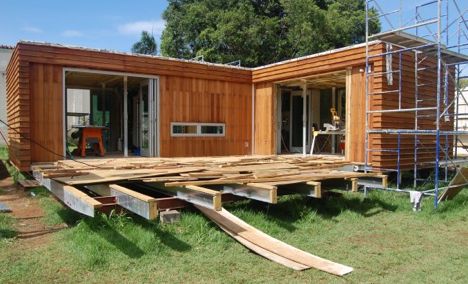
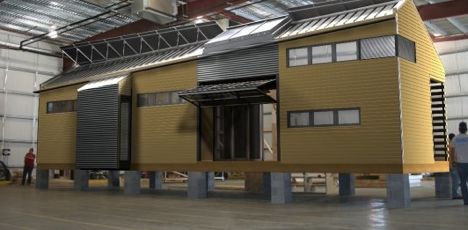
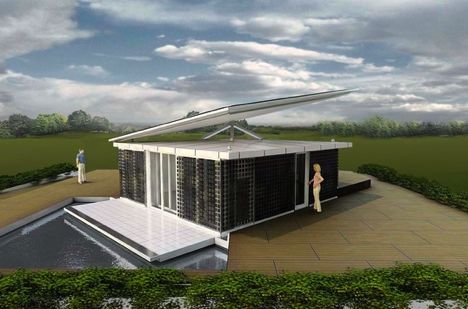
Yesterday we mentioned the EPA's Lifecycle Building Challenge. We're most intrigued by last year's winning student entry, Texas A&M's groHome:

Using a library of pre-manufactured components brought to a site and assembled efficiently, the structure is designed with a specialized bolted connector [joint] that allows for components to be unplugged easily and without damage. Radio Frequency Identification Tags (RFID) can be embedded to take inventory and check the history of components.

More detail on the "gro(w)ability" of the home:

The plug and play concept is taken from the computer industry. .... The chrysalis of this idea is in our joint, the groJoint. It is designed to receive a beam on four sides and column or foundation on the top and bottom. Connections are all bolted which allows for components to be "unplugged" easily and without damaging the component....

The Texas A&M Solar Decathalon Website has more background information on the team and the project.

A few of the prefab companies we cover already use similar standardized systems:

0 comments, 0 trackbacks (URL) , Tags: system process

The EPA's Lifecycle Building Challenge; July 31 deadline

Link to The EPA's Lifecycle Building Challenge; July 31 deadline
http://www.lifecyclebuilding.org/

We missed this item last year when we covered West Coast Green 2007: the EPA's Lifecycle Building Challenge. From a West Coast Green email:

... a design competition for students and professionals focusing solely on innovation regarding deconstruction and building material reuse.

And the Lifecycle Building Challenge was born! Submissions from architects, students, planners and builders poured in, ranging from de-nailer guns to radio-tagged, re-useable wall panels to design that considers reuse as it's primary function.

The awards were presented last year at West Coast Green.

The Challenge returns to this year's show. The ability to take apart a building and re-assemble it elsewhere seems like prefab in its purest form.

where: West Coast Green 2008
deadline: July 31, 2008

0 comments, 0 trackbacks (URL) , Tags: green system process West Coast Green

WIRED LivingHome still for sale; price reduced

Link to WIRED LivingHome still for sale; price reduced
http://www.rochedaleln.com/download/editing/flash/013.jpg

We first looked at the WIRED LivingHome back in July 2007. The home was open to the public in November and shortly thereafter was put on the market. According to Curbed LA:

...the home, originally listed at $4.15 million, has been re-staged and priced at $3.75 million.

Likely, the nation's real estate slump has something to do with the price revision. If you're looking for a top-of-the-line prefab though, here's what you get:

  • 5 bedrooms
  • 4 bathrooms
  • 4,057 sf
  • $924/sf

Tons of pictures are available at Redfin and on the home's own site. Curbed toured the home in November and provides some additional photos.

Our other coverage:

designer: Ray Kappe for LivingHomes
where: Brentwood, CA
price: $3.75m
details: 5 br, 4 bath, 4,057 sf

0 comments, 0 trackbacks (URL) , Tags: LivingHomes for sale California

This week: Marmol install, Chile, and BURST

The LA Times featured the above video (3:03, following a short advertisement) of the install of the Marmol Radziner prefab in Venice, CA that we mentioned last week.

Jetson Green enjoyed the video:

It's fun ... because you can see Ron Radziner's enthusiasm bubble inside as he explains one of his company's newest creations. These guys are having fun, you can just tell.

Inhabitat's Prefab Friday took a look at La Reserva:

This stunning prefab in Colina, Chile, is the work of Santiago-based architect Sebastián Irarrázaval. Despite its unique form, it is not meant as a custom design but rather a housing solution that can take shape repeatedly. Constructed of concrete, steel and timber, the 120 square meter structure (1290 sq ft) lives large with a simple geometric that is at ease with the surrounding landscape.

Plenty Magazine's blog covered the BURST* models that will be a part of the upcoming Home Delivery exhibition at MoMA:

“Everyone thinks prefab is just a big chunk of house you dump on a site and then you bolt it down,” says [designer] Gauthier. “Ours is a little bit more like an Ikea project. It’s thousands of pieces that can all be handled and stitched together on site.” Though the interior of the Burst*008 house will be modified to respond to the constraints of New York City and the MoMA’s specific building requirements, the structure will share many attributes with its Australian seaside counterpart.

0 comments, 0 trackbacks (URL) , Tags: video Marmol Radziner This Week BURST*

The LA Times on Sander Architects and steel framing

Link to The LA Times on Sander Architects and steel framing
http://www.latimes.com/classified/realestate/news/la-re-metal8-2008jun08,0,6176670.story

Sander Architects designs homes that use prefabricated steel skeletons. The Los Angeles Times discusses the advantages of steel:

With costs below those of conventional building methods, quick and easy assembly and no termite issues, prefabricated or pre-engineered steel buildings are finding a place in the residential home market.

Homeowner Thomas Small explains part of his reason for choosing steel:

"Most of the metal in this house is recycled and will be recyclable at the end of its use in this house," Small said.

"And there's also very little waste with metal. It was made at the factory and then shipped here. There was no sawdust. No cutting," he said. "And we didn't have to hire specialized builders. It was built by the contractor who built the rest of the house, and bolted together very easily."

Firm principal Whitney Sander describes the process:

"It fits together like an erector set," Sander explained. "And it goes together in three weeks. The inside takes longer, but the prefabrication can save you months and thousands of dollars."

Some numbers from recent Sander Architects projects:

Two projects completed within the last year cost about $130 per square foot or about one-third of traditional custom residential costs, which can top $400 per square foot, according to Sander.

Small's construction costs were about $175 to $200 per square foot, compared with $120 to $350 for traditional non-custom homes, according to construction experts.

These sounds like impressive savings, though finishes and other construction unrelated to the steel skeleton play a large part in determining final construction costs. Read the complete article for more about Sander Architects and steel framing.

author: Michelle Hofmann
publication: The Los Angeles Times
length: 1,000 words
publication date: June 8, 2008

0 comments, 0 trackbacks (URL) , Tags: cost Sander Architects steel
Our aim is to create the web's #1 resource for prefab and modular homes. Read our blog for daily news, and browse around to learn more about the emerging world of prefab.